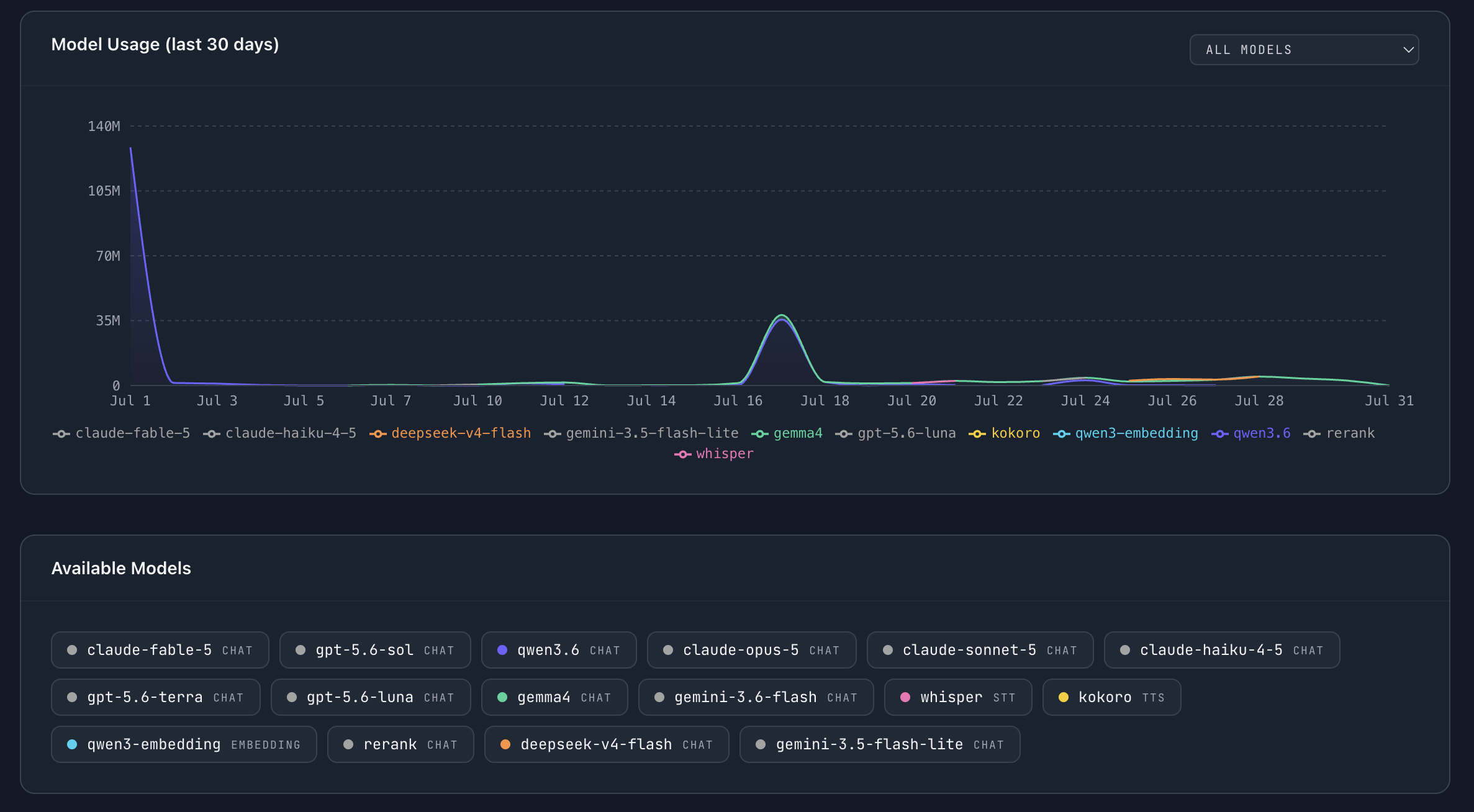
Helmcode serves nine open-weight models behind one OpenAI-compatible API at https://api.helmcode.com/v1. Every model works the same way: only the model id changes. Eight of them are covered by your plan; GLM 5.3 is a per-key add-on and has its own section below. Use the id exactly as shown. For limits and quotas, see Rate limits.
Language models
Zglm5.3sotaflagship744B MoE · 40B active · NVFP4 · 1M context
The strongest open model we serve, and it ties the highest-scoring open-weight model there is: long-horizon agentic coding over a real repo, plus competition-level maths. It is multimodal: it takes text, images, video and audio. Sold per key at €150 a month rather than covered by your plan, with its own section below.
Capabilities
Tool calling · reasoning (low · medium · high · max) · vision · video · audio · streaming (SSE)
Zglm5.3-flash320B MoE · 18B active · NVFP4 · 1M context
The light model of the GLM 5.3 family, on a fraction of its weights: it reads images and video as well as text, holds a 1M window and is covered by your plan, in the same monthly quota as deepseek-v4-flash. Our default for coding agents.
Capabilities
Tool calling · reasoning (low · medium · high · max) · vision · video · streaming (SSE)
Best for
Agentic coding, screenshots and documents, long-context analysis
deepseek-v4-flashsotaflagship552B MoE · 8B-16B active · NVFP4 · 1M context
DeepSeek V4.1 Flash, served under the same id. Flagship for complex, agentic work: long documents, deep codebases, and multi-step tool use.
25MB / ~2 min per request · 10 rpm · OGG/Opus, MP3
Best for
Transcription, meeting notes, voice search
On Dedicated and On-premise plans you can also run custom or fine-tuned models on hardware reserved for you. See Examples for how to call each family.
add-on · €150 per key a month · runs in the EU
GLM 5.3, sold per key
The strongest open-weight model we serve, and the one the catalogue above does not describe well: it runs on our own hardware in the EU with zero logs, like everything above, but a plan does not cover it. You add as many keys with GLM 5.3 as you need, at €150 a month each, on top of any enterprise plan. It has been the per-key add-on since 3 September 2026, at the same price and per-key limits, with the served context raised to the full 1M.
What a key includes
Price
€150 per key a month, on top of any enterprise plan
Requests per minute
100 rpm
Concurrency
10 concurrent requests
Tokens per minute
3M tpm
Context
1M per request
The model takes 1M of context and we serve all of it per request, where we previously served up to 500K. GLM 5.3 is multimodal: besides text it takes images, video and audio.
The monthly allowance is your tier’s, not the key’s
Volume is capped per organisation and shared across every key on the account, separately from the plan quota that covers the models above:
Plan
GLM 5.3 tokens a month
Starter
2,000M
Growth
6,500M
Scale
18,000M
When the allowance runs out, GLM 5.3 pauses until the next billing cycle and everything else keeps answering. There are no overage charges.
Every chat model above thinks before it answers, and the reasoning trace arrives separately from the answer, in `message.reasoning_content`. How much a model is allowed to think is a request parameter, `reasoning_effort`, and each model applies it differently: the table is the contract. deepseek-v4-flash reasons adaptively: `none` turns the reasoning phase off, and the other levels shift how much it thinks — they steer the model, they do not hard-cap it.
Model
reasoning_effort values
What it does
glm5.3 · glm5.3-flash
low, medium, high, max
Fully controllable. Higher values let the model reason longer before it answers; max is the deepest.
qwen3.6
none, minimal, low, medium, high, max
none and minimal skip the reasoning phase entirely. The other four cap it: low 2,048, medium 8,192, high 16,384, max 32,768 tokens.
gemma4
none, minimal, low, medium, high, max
Same as qwen3.6: off, or a reasoning budget between 2,048 and 32,768 tokens.
deepseek-v4-flash
none, minimal, low, medium, high, max
none skips the reasoning phase entirely. The model stays adaptive on every other level: minimal to max steer how much it reasons, but they are hints, not hard token budgets.
With no parameter, every model uses its own default (reasoning on for qwen3.6 and gemma4, with a 16,384-token budget; adaptive for deepseek-v4-flash). More reasoning costs latency and counts toward `max_tokens`; it never costs extra setup.
Example
curl https://api.helmcode.com/v1/chat/completions \
  -H "Authorization: Bearer $HELMCODE_API_KEY" \
  -H "Content-Type: application/json" \
  -d '{
    "model": "glm5.3",
    "reasoning_effort": "high",
    "messages": [{"role": "user", "content": "Prove that the square root of 2 is irrational."}]
  }
qwen3.6 and gemma4 answer fastest with "none": the reasoning phase is skipped entirely.
separate offer · paid from credit · runs outside the EU
Frontier models from OpenAI, Anthropic and Google
The same API also serves nine frontier models from three US providers. This is a separate offer from the open-weight catalogue above, and they differ in the two things that decide a model for most buyers: who runs the hardware, and what pays for the tokens.
Nothing above changes. Our own models keep running on hardware we operate in the EU, and a monthly plan keeps covering them at a flat rate.
They run on the provider’s infrastructure, in the United States
Each of these models runs on Anthropic, Google or OpenAI. Your messages, attachments and the replies are sent to whichever of them serves the model you pick, and processed on that provider’s infrastructure outside the EU. Our own models run on hardware we operate in the EU and nothing leaves it. The console shows the same notice next to the model you are choosing, because that is the moment the decision gets made.
Paid by the token, out of prepaid credit
No monthly plan covers them, at any tier, with any allowance left. An organisation with a plan and no credit still sees them and can select one, and the request is refused until the balance is topped up. Your plan allowance is left untouched and keeps working on our own models.
Provider list price, no markup on inference
On input, output and cache reads we pass each provider’s list price through with nothing added. What we publish is exactly what we debit, which is what lets you reconcile a statement against the rate card line by line. Our revenue on these models is the fee charged when you buy credit, not your consumption.
The nine models
Same catalogue and same key as everything above. They are returned by the model list endpoint alongside our own, and the id is the only thing that changes.
Model
Provider
claude-fable-5
Anthropic US
claude-opus-5
Anthropic US
claude-sonnet-5
Anthropic US
claude-haiku-4-5
Anthropic US
gpt-5.6-sol
OpenAI US
gpt-5.6-terra
OpenAI US
gpt-5.6-luna
OpenAI US
gemini-3.6-flash
Google US
gemini-3.5-flash-lite
Google US
The nine appear in the same model list as our own, in the console.
Where the price is, and why it moves
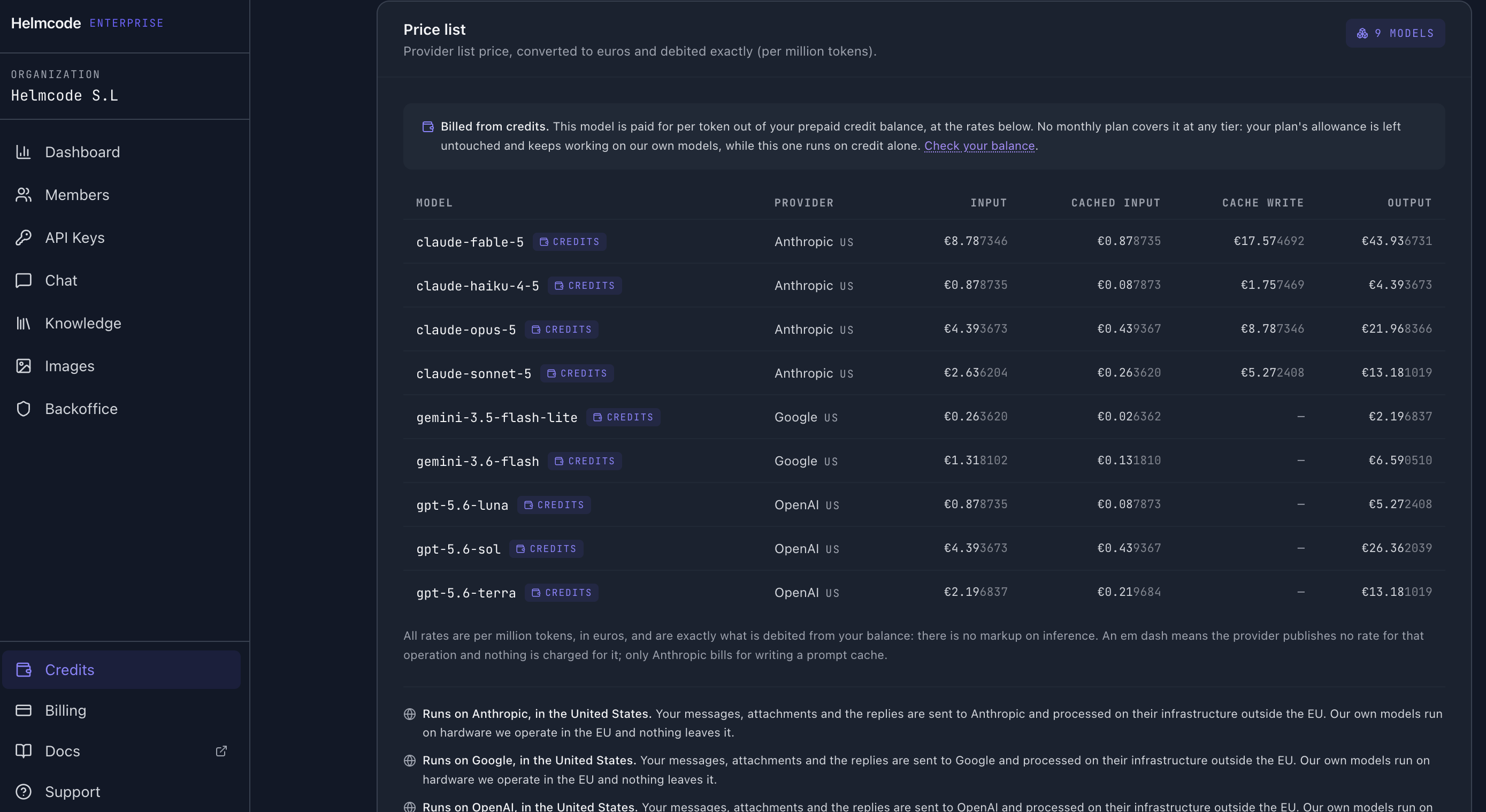
The rates are not published here, deliberately. A rate lives in exactly one place, and that place is the thing that charges it: your console, under Credits, on the Private models tab. There you get the full price list, the four rates per model (input, output, cached input and cache write), and what each model has cost you so far.
The price list in the console: nine models, their provider, the US residency marker and the four rates. That is the rate your requests are billed at.
Those rates move, and it is worth knowing why, so that a change does not read as a whim of ours. We pass each provider’s list price through with no margin, which means we are not the ones setting it: when a provider reprices, ours follows the same day. And because we charge in euros while the providers publish in dollars, the euro amount also follows the euro to dollar reference rate. Both of those sit outside our control, which is exactly why the number belongs in one always-current place rather than on a page that can quietly go stale between deploys.
Anthropic charges for writing a prompt cache, the other two do not
A prompt cache lets a model re-read a long prefix (a system prompt, a document, a codebase) without paying the full input rate for it again. OpenAI and Google charge a reduced rate to read one and nothing at all to create it. Anthropic charges a premium to write and a discount to read, which makes the write a fourth billed class rather than a discount, and that is why the price list carries a cache write column that is empty for the other six models.
We publish and debit one Anthropic cache write rate, whatever the lifetime of the entry. Anthropic itself bills less for a short-lived cache, so on those writes our rate sits above theirs. We publish it instead of folding it into the input rate, because a rate we charge and do not show would be a markup in everything but name. Your statement lists all four quantities separately, so the arithmetic stays checkable: quantity times published rate, for each of the four, adds up to what was charged.
Calling one
Same base URL, same key, same request body. Only the model id changes.
If the balance runs out the API answers 402 credits_exhausted and only these models refuse: everything your plan covers keeps answering, so one refusal is not an outage. The balance never goes negative. When a request costs more than what is left we charge what was there and absorb the difference.