Skip to the stories
HelmcodeRESEARCH

PRESS KIT

The State of Open Models 2026

Research, data and charts on the open-weight AI ecosystem.

Helmcode Research ·

Download the press packZIP · 8.6 MB Read the report Methodology

01

Story angles

Six stories the data support, each with the warnings that come with it.

01 Agentic work and cost

An open-weight model nearly matched Claude Opus 5.5 on long agentic tasks, at less than half the cost per solved task

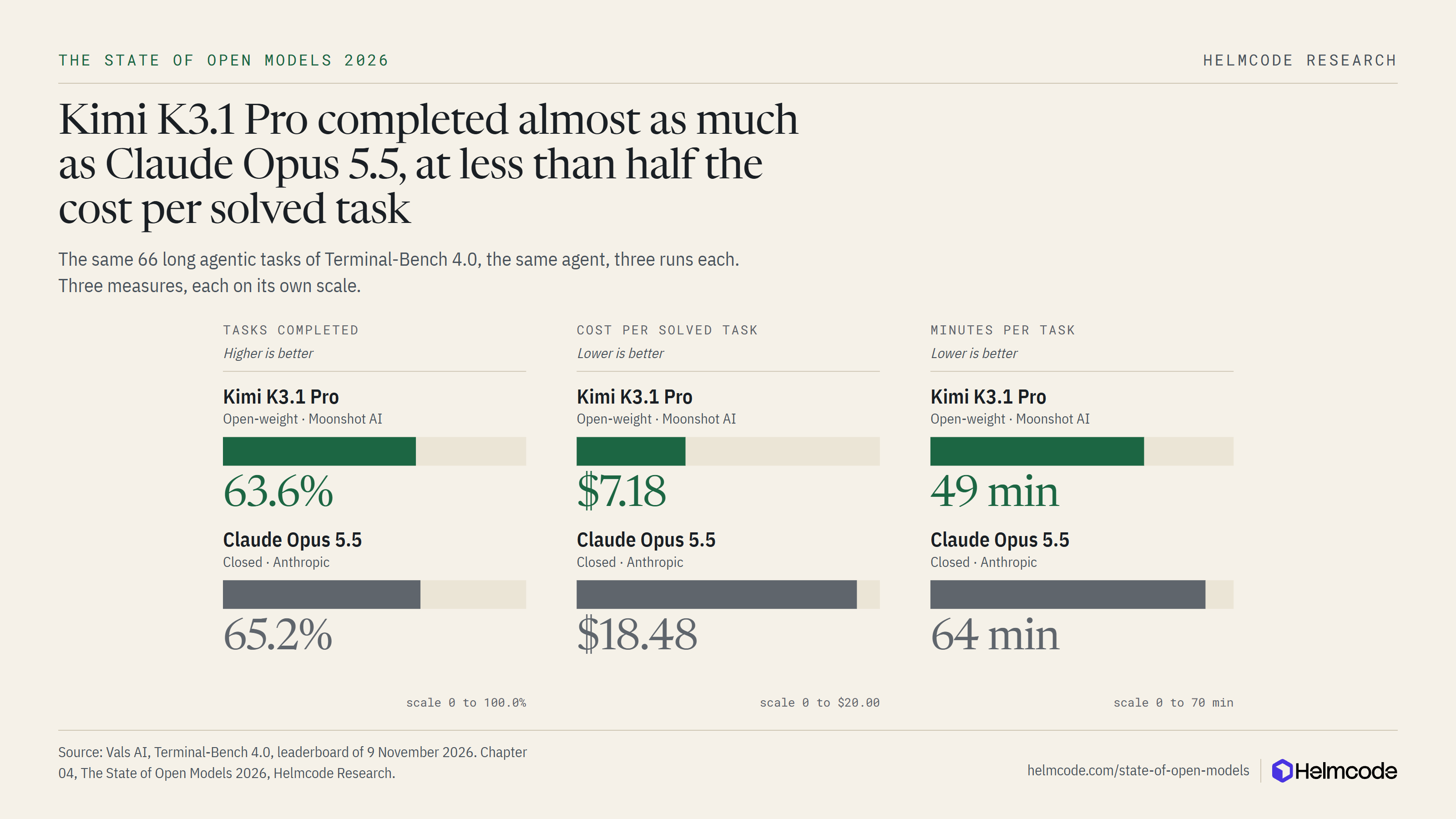
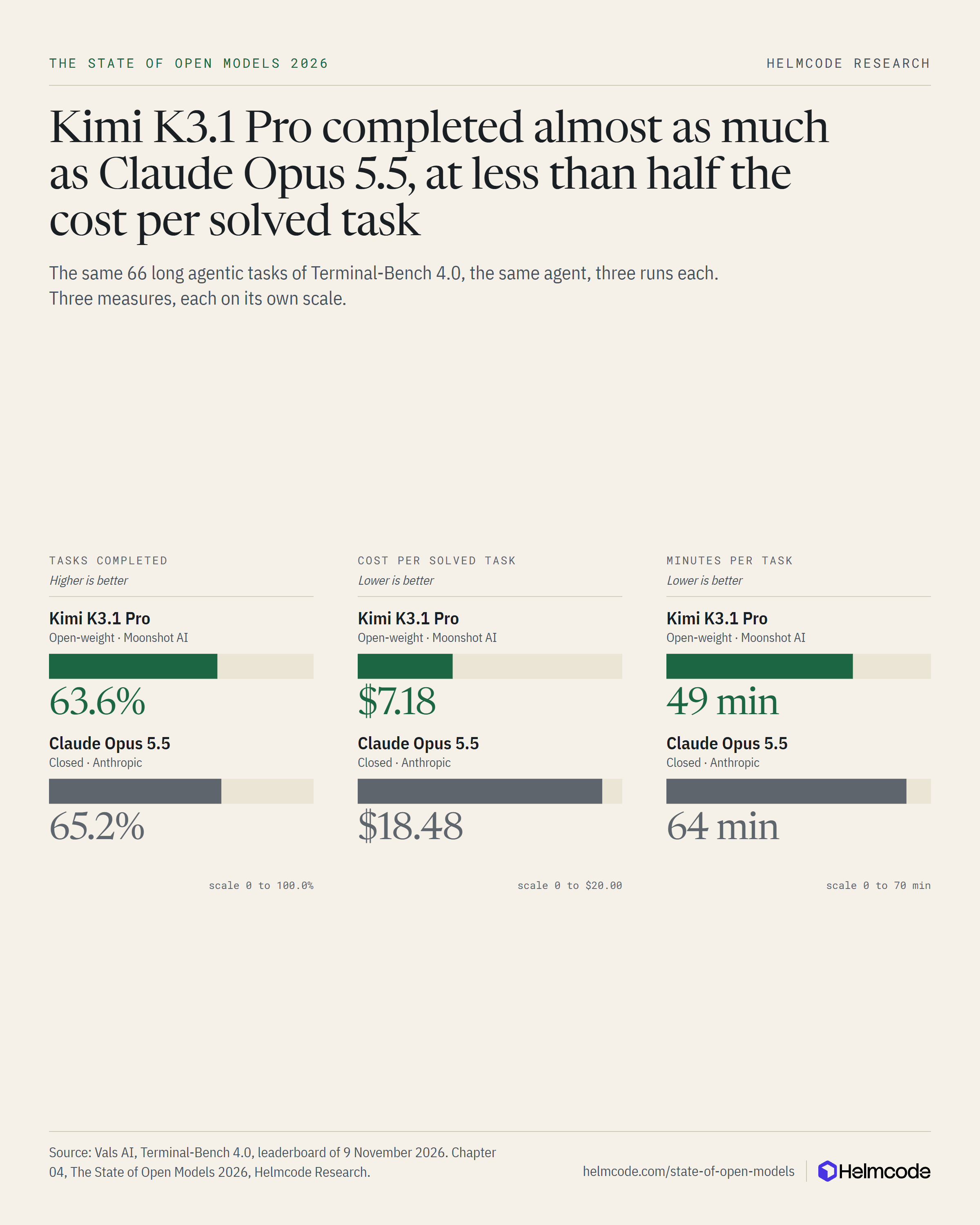
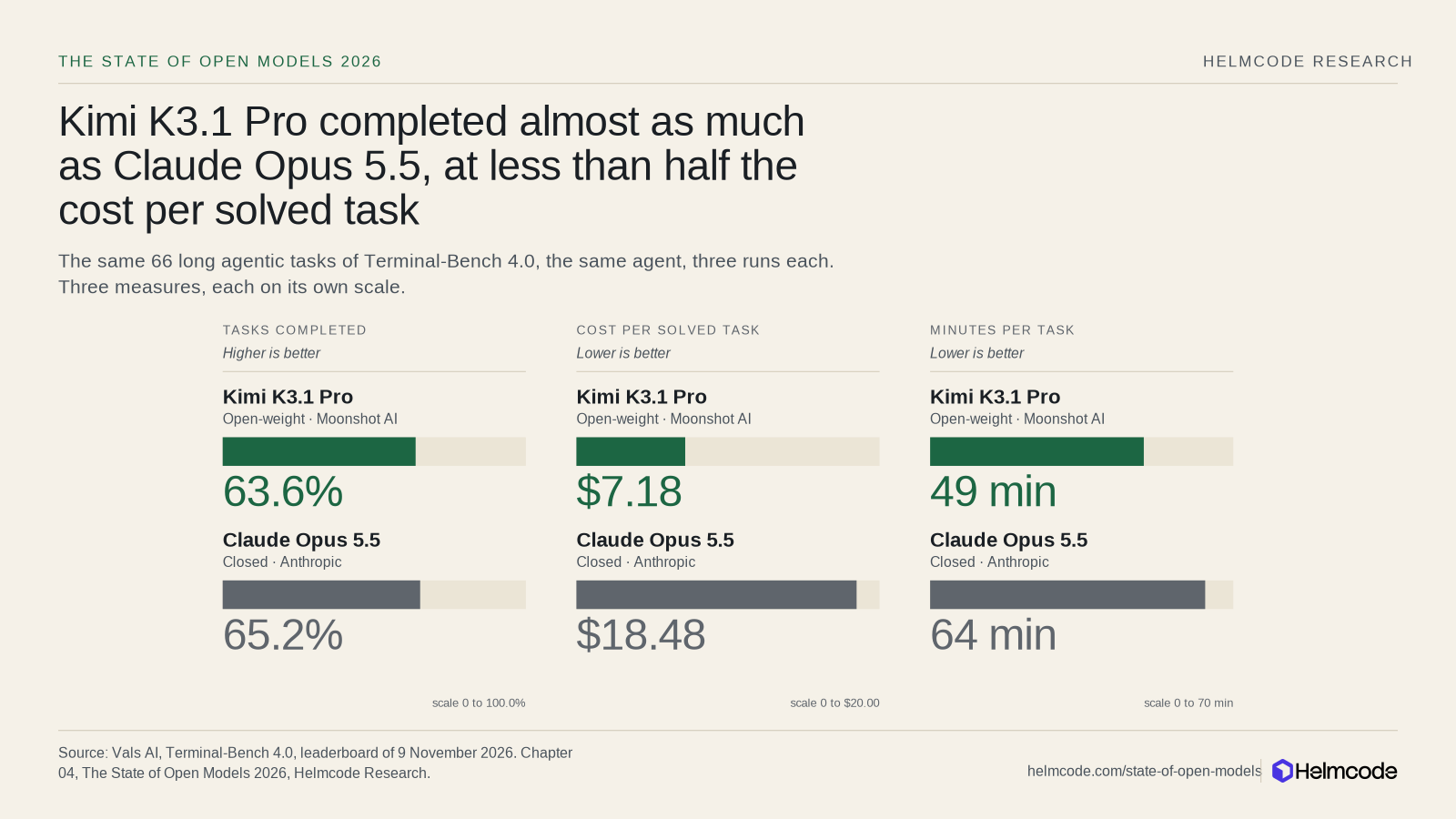
Kimi K3.1 Pro completed almost as much as Claude Opus 5.5, at less than half the cost per solved task

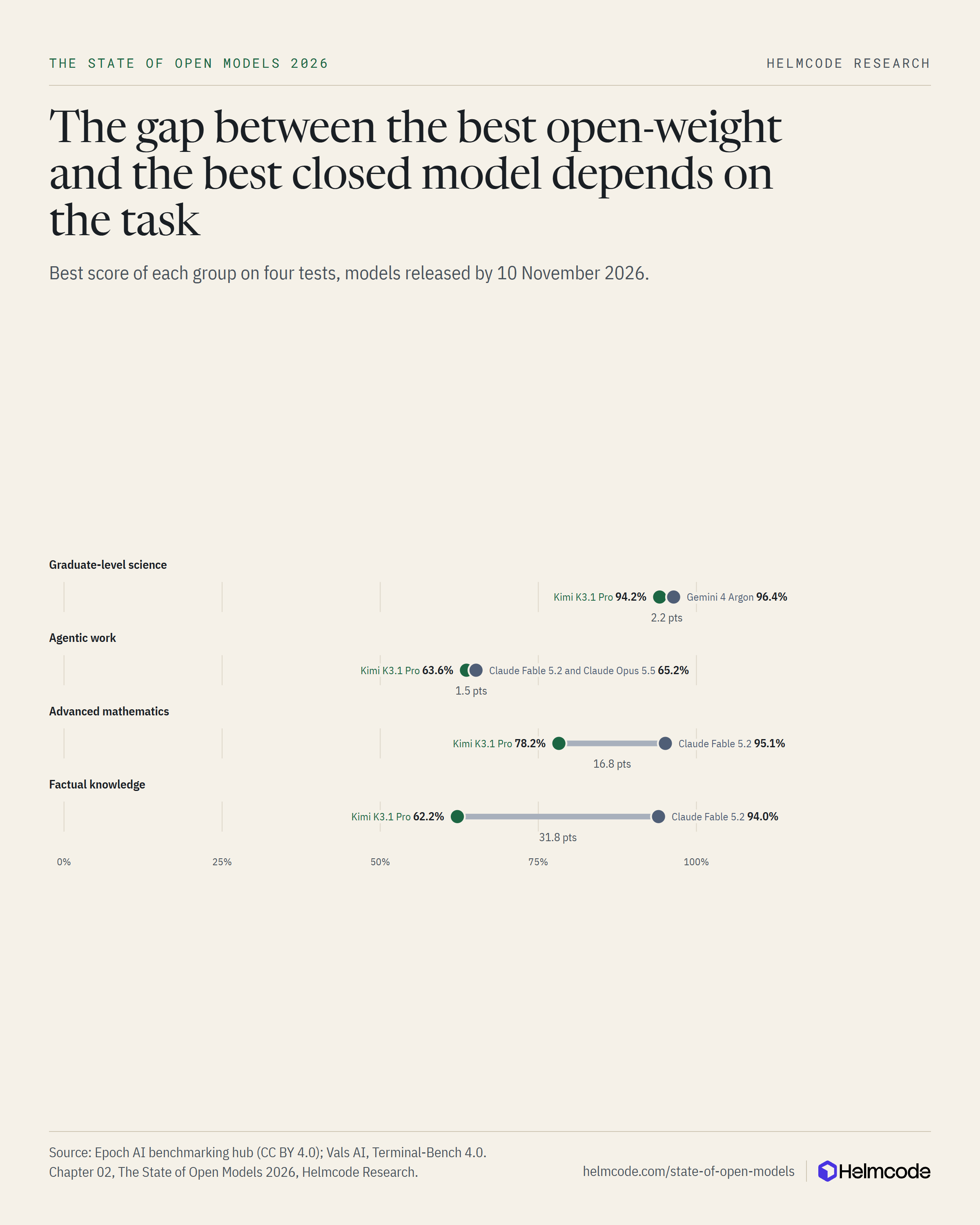
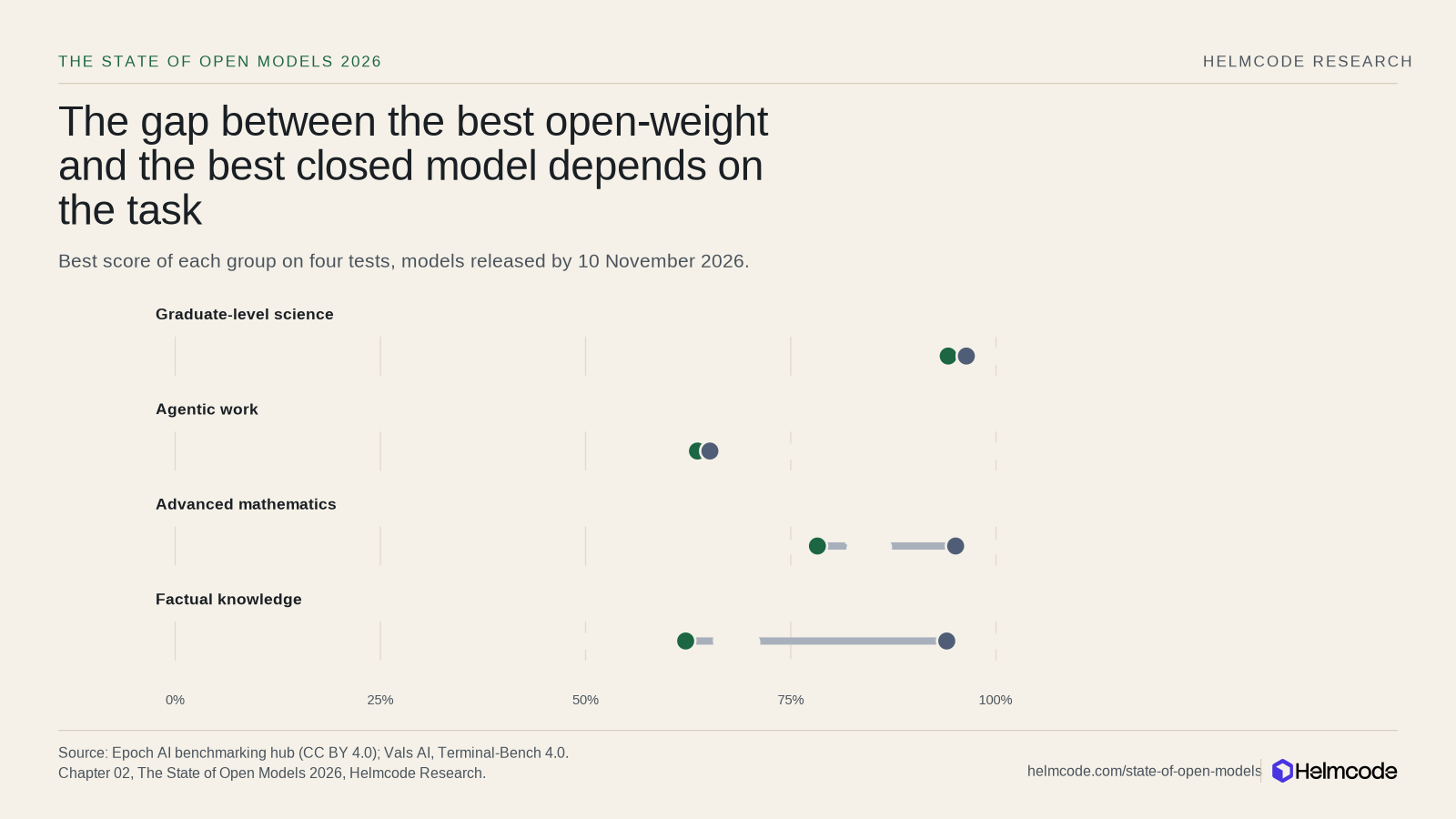
On the same 66 long agentic tasks, run with the same agent by Vals AI, Kimi K3.1 Pro completed 63.6% at $7.18 per solved task; Claude Opus 5.5 completed 65.2% at $18.48. Opus still completed slightly more tasks.

  • Kimi K3.1 Pro does not beat Claude Opus 5.5 overall: on this test it completed fewer tasks.
  • One benchmark, one provider per model. The cheapest strong result is closed: GPT-6.1 Sol, 55.0% at $3.13.
How it was measured

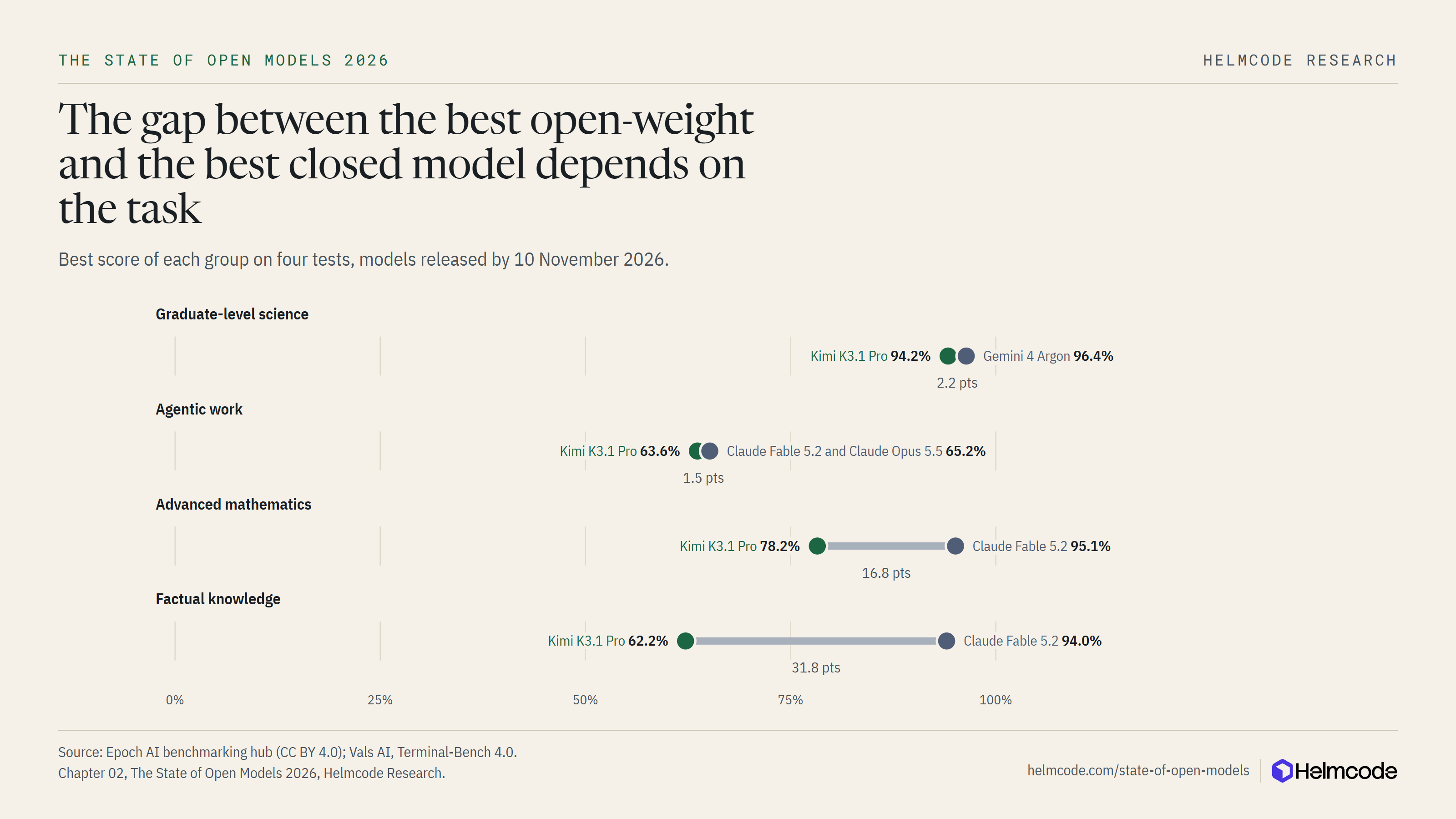
Vals AI ran 47 models released by 10 November 2026 through the same agent (mini-SWE-agent) on the 66 tasks of Terminal-Bench 4.0, three times each. Cost per solved task is the API bill at the serving provider's prices divided by the share of tasks completed, so failed attempts are paid for. On another, independent test, Epoch AI's GPQA Diamond, Kimi K3.1 Pro scored 94.2% and Claude Opus 5.5 90.6% (the report's open data file); the two tests should not be combined.

63.6%
65.2%
Tasks completed
$7.18
$18.48
Cost per solved task
49
64
Minutes per task

Vals AI, Terminal-Bench 4.0 · Leaderboard of 9 November 2026

02 Downloads and usage

Qwen dominates downloads; DeepSeek leads token usage

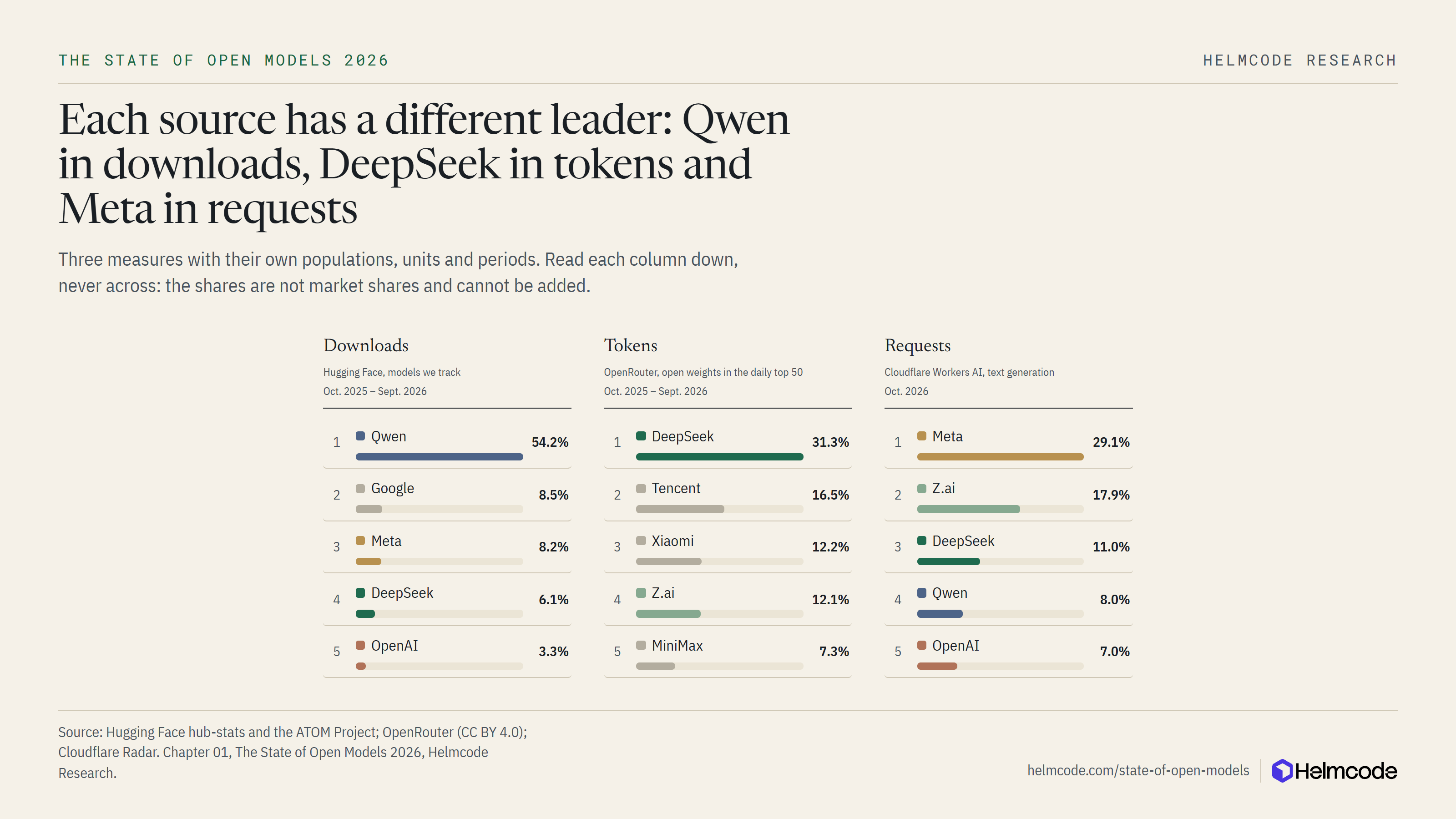
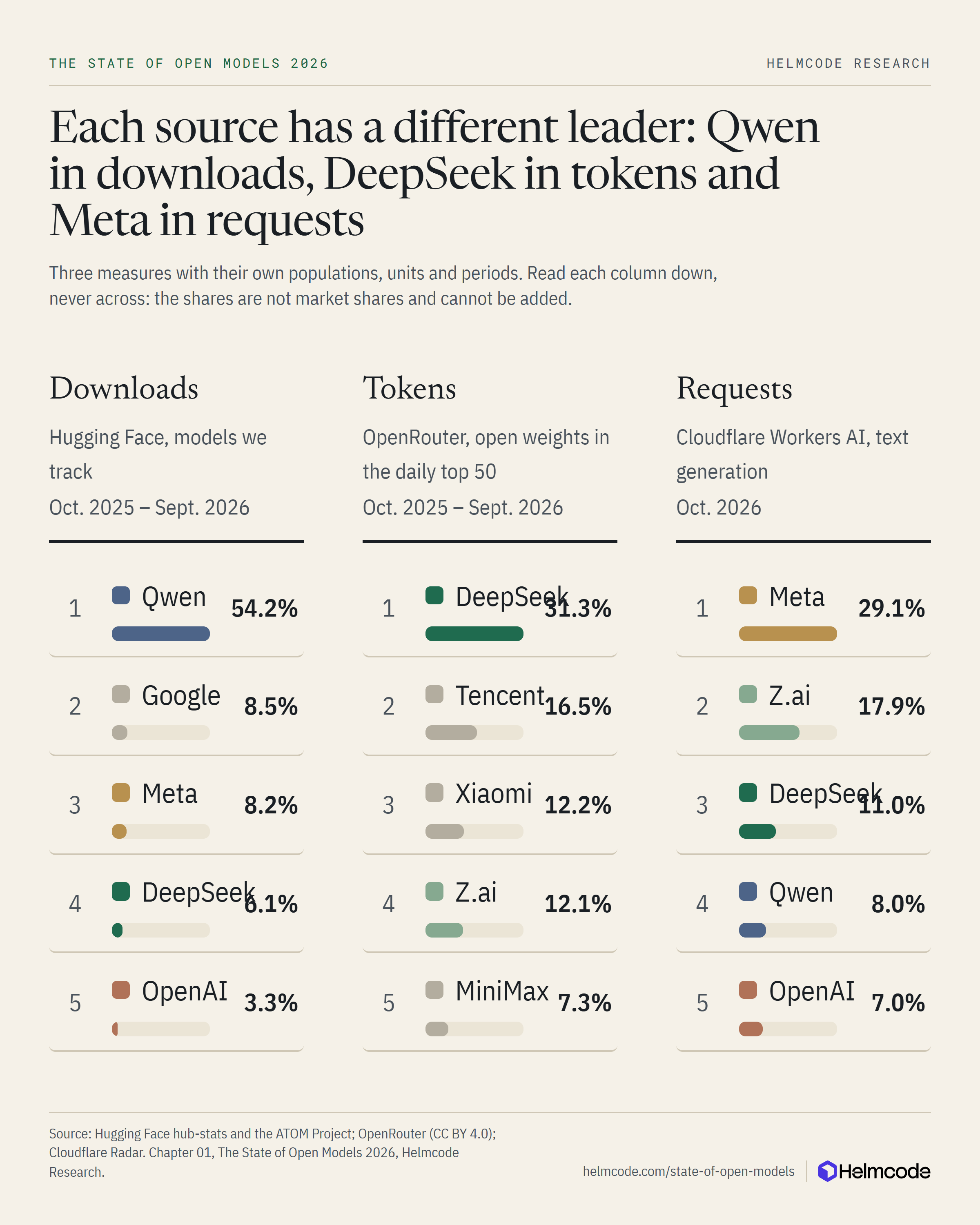
Each source has a different leader: Qwen in downloads, DeepSeek in tokens and Meta in requests

From October 2025 to September 2026 Qwen took 54.2% of the downloads the report tracks on Hugging Face. In the same months it took 1.0% of the open-weight tokens in OpenRouter's daily top 50, where DeepSeek led with 31.3%. Downloads and use do not always go together.

  • A download is a request for files, not a user; a token is traffic on one platform. The two shares are not market shares and cannot be compared.
  • Write “downloads we track”: the sample is a list of models, not all of Hugging Face.
How it was measured

Downloads: the open models on the ATOM Project's tracked list, first-party repositories only, summed over twelve 30-day readings of Hugging Face. Tokens: open-weight versions in OpenRouter's daily top 50, October 2025 to September 2026 (60% of the top 50's tokens).

54.2%
Qwen, downloads
31.3%
DeepSeek, open-weight tokens
1.0%
Qwen, open-weight tokens

Hugging Face hub-stats and the ATOM Project; OpenRouter · October 2025 – September 2026

03 Model turnover

AI model versions are replaced within months; the labs behind them last longer

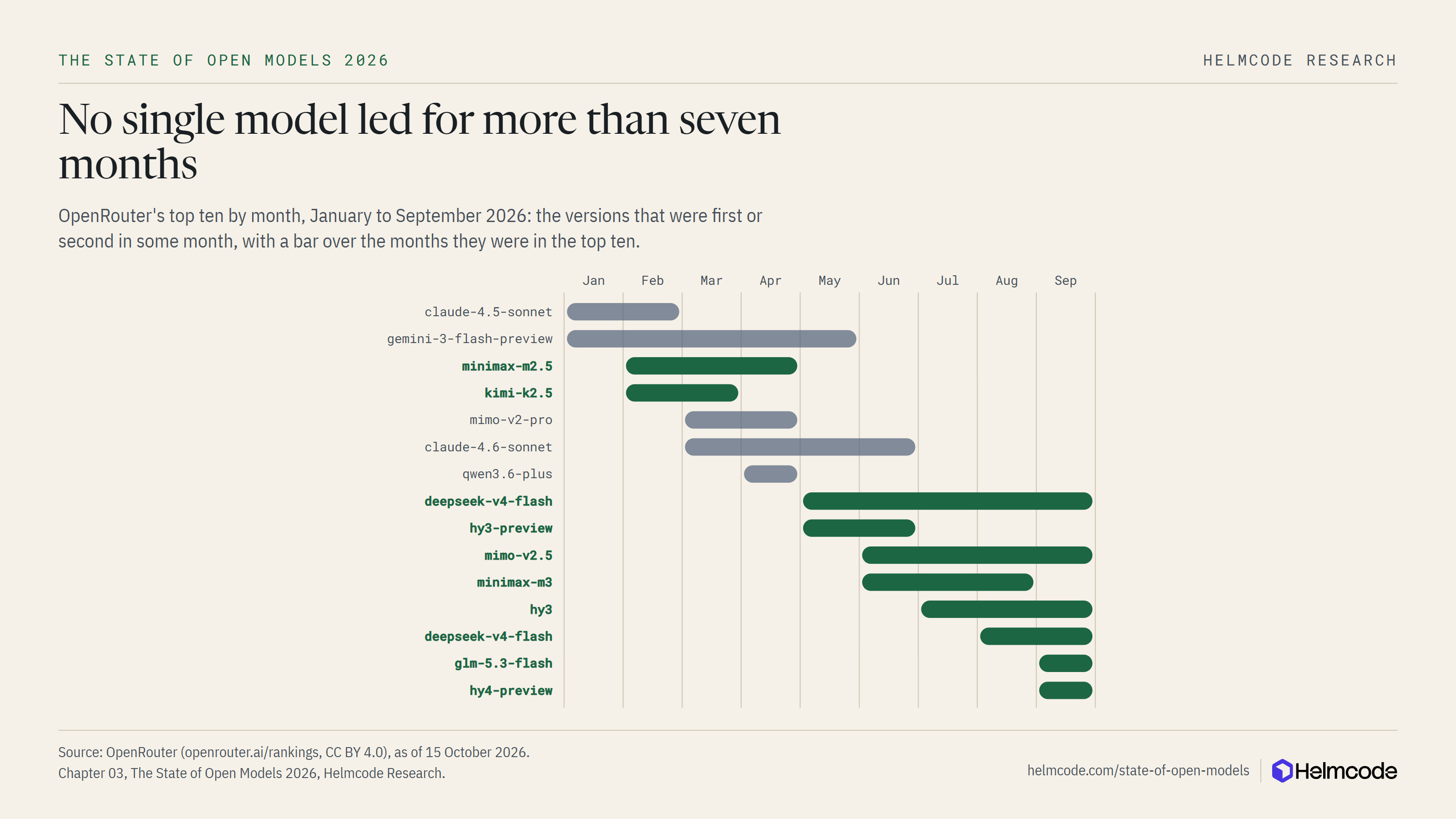
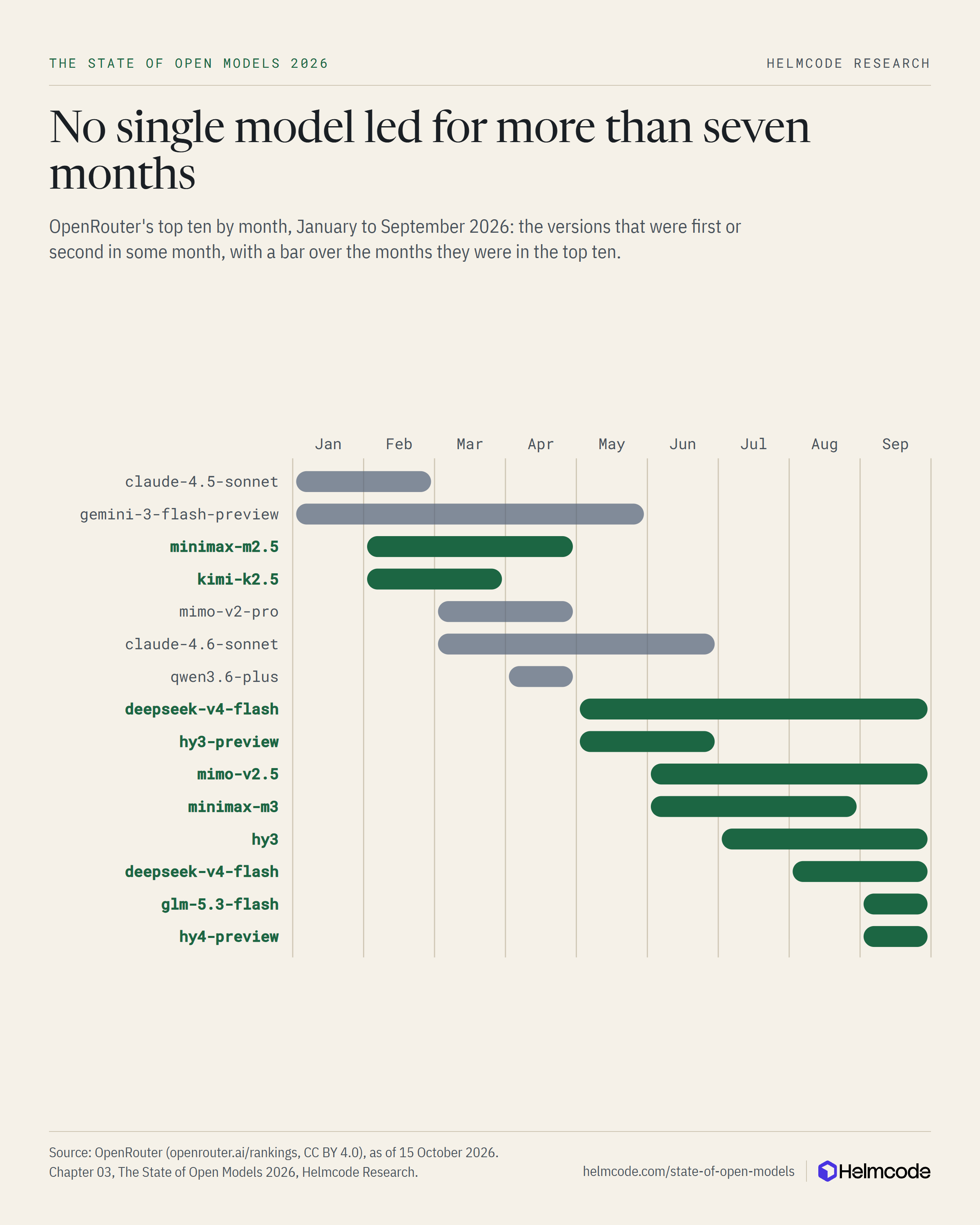
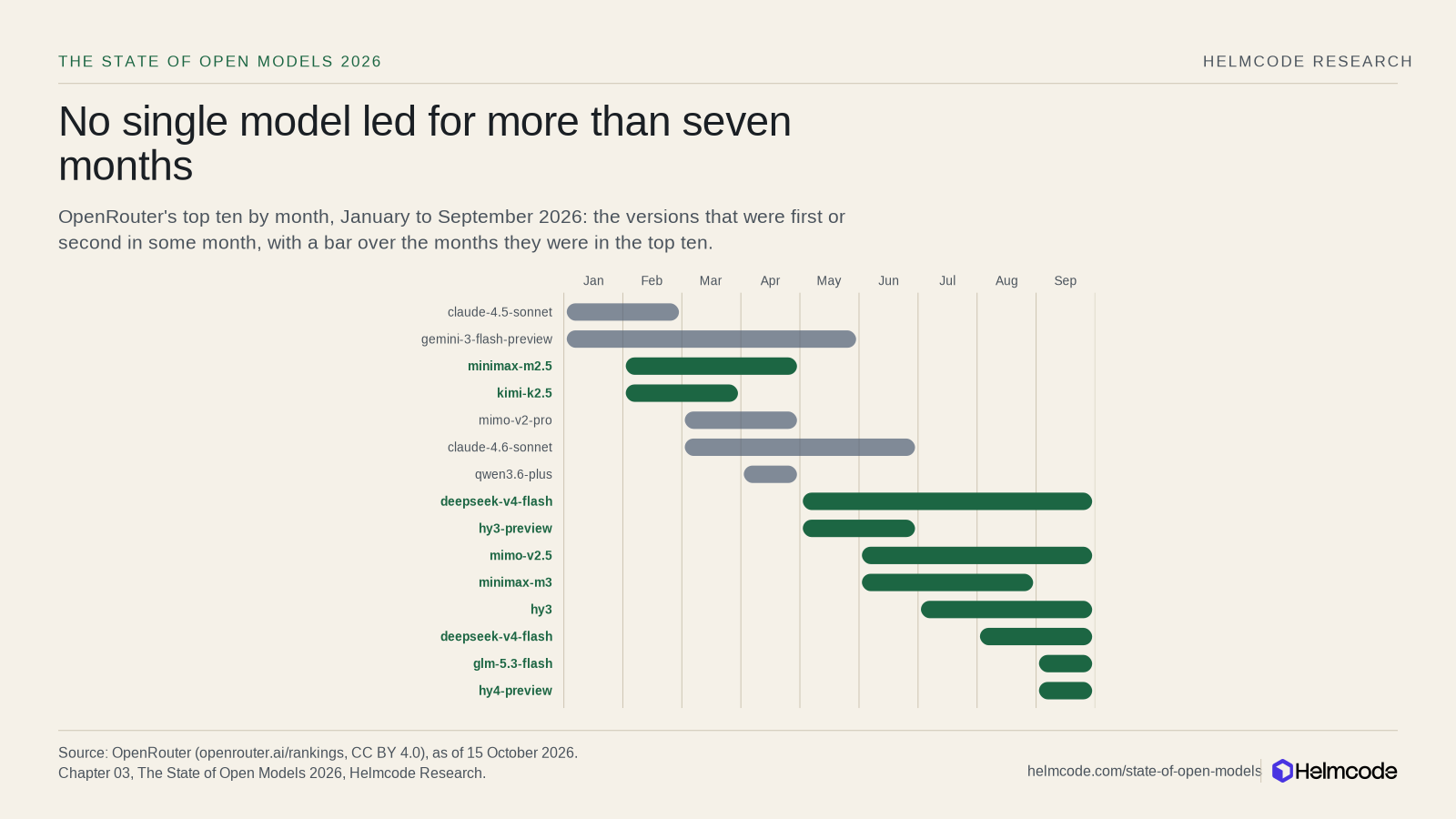
No single model led for more than seven months

None of January 2026's ten most used versions on OpenRouter was still in September's top ten. DeepSeek was the most used open lab in nineteen of the twenty-one complete months since January 2025, but no single model led for more than seven months.

  • A version is a dated OpenRouter identifier. The data do not say which versions form a family, so the report measures versions and labs, not families.
  • OpenRouter is one platform; its ranking is not the market.
How it was measured

OpenRouter's public rankings: daily token counts for the 50 most used versions, open and closed, April 2025 to October 2026, retrieved on 15 October 2026. A version enters on the first day it appears in the daily top 50. Six-month survival: of the 196 versions that first entered between February 2025 and 22 April 2026, the share present on the day six months later.

76%
Tokens to versions under 90 days
19%
Versions still in the top 50 after six months
7 months
Longest run of one model in the lead

OpenRouter rankings · April 2025 – October 2026

04 Cost per task

The cost of AI is not the price per token

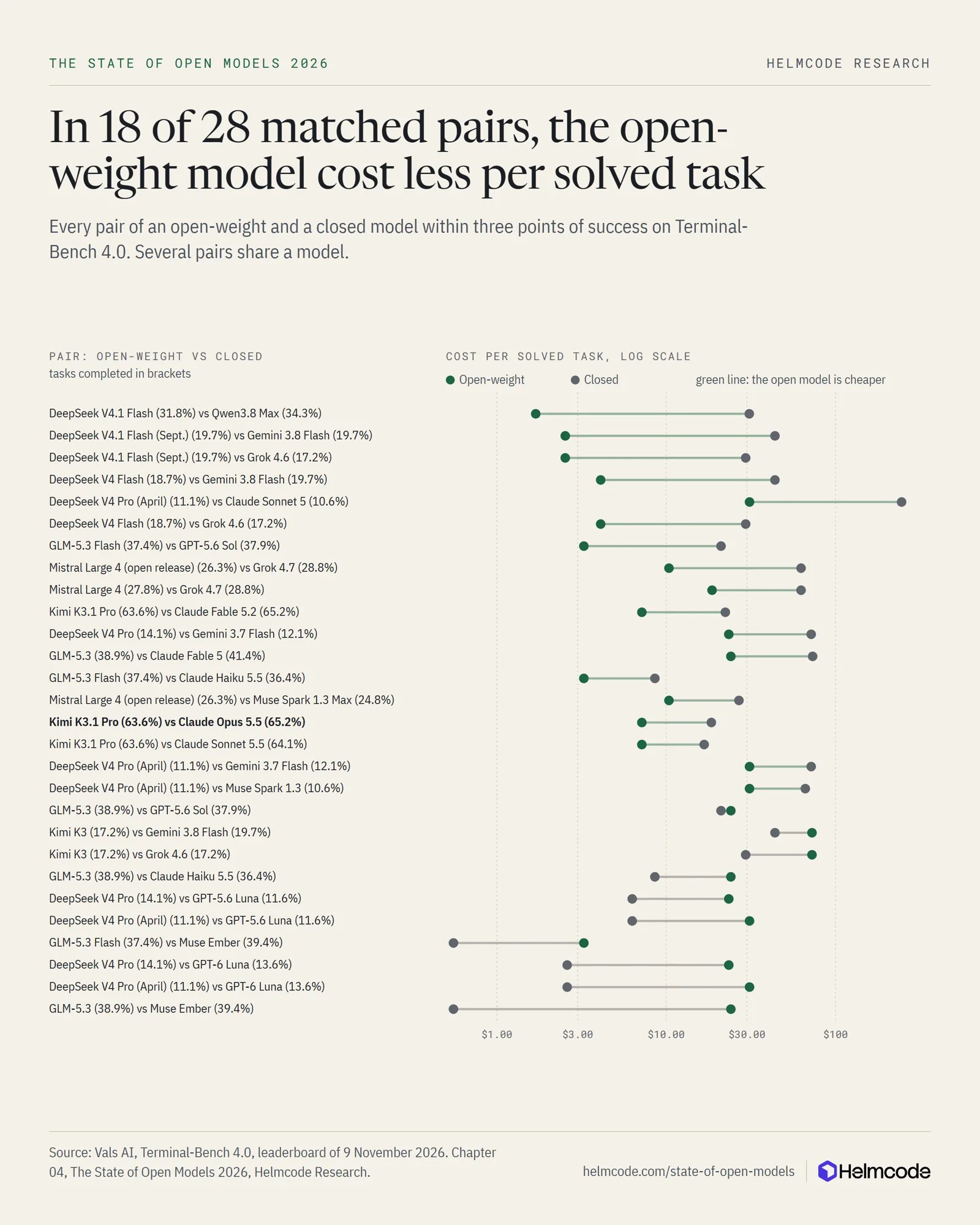
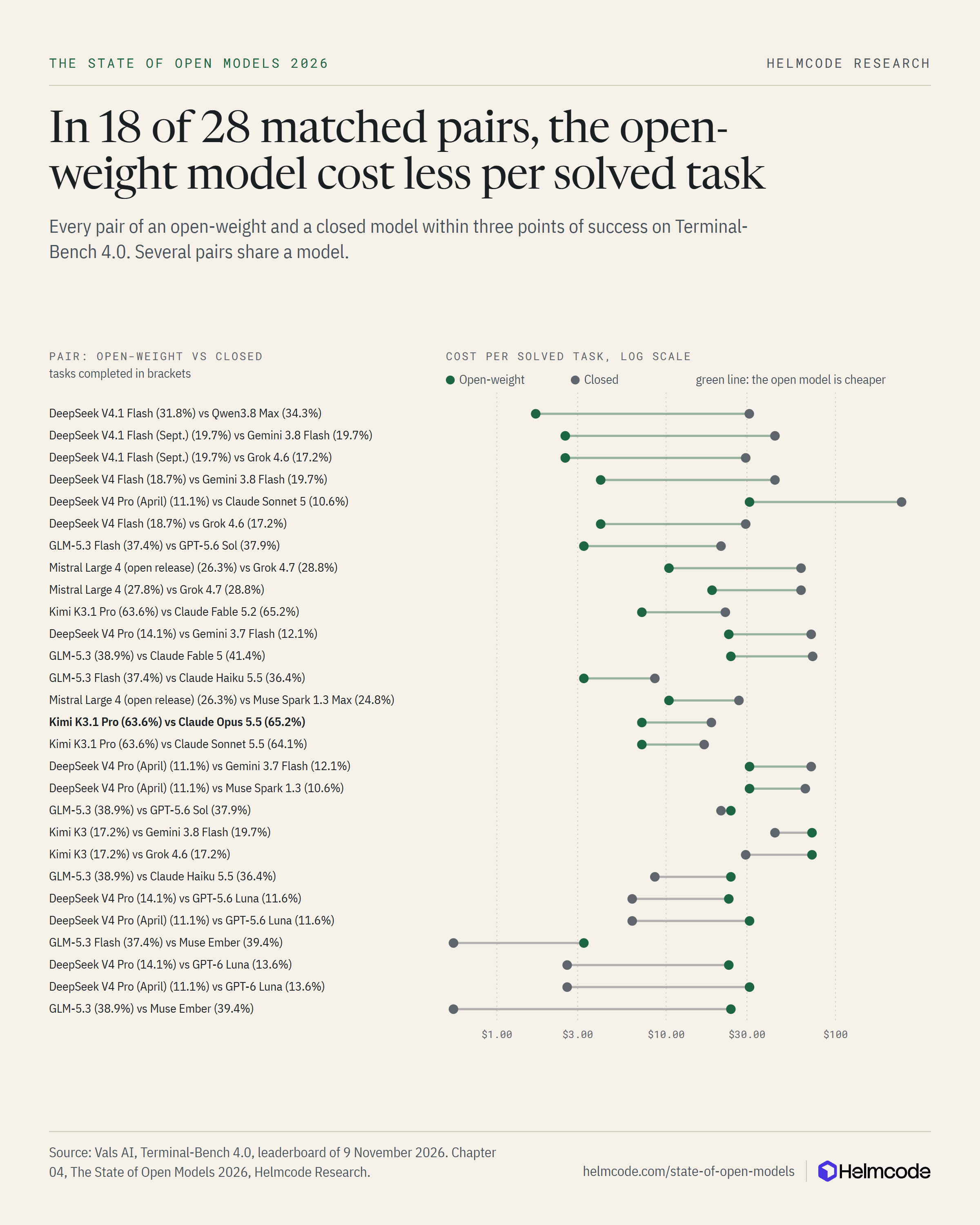
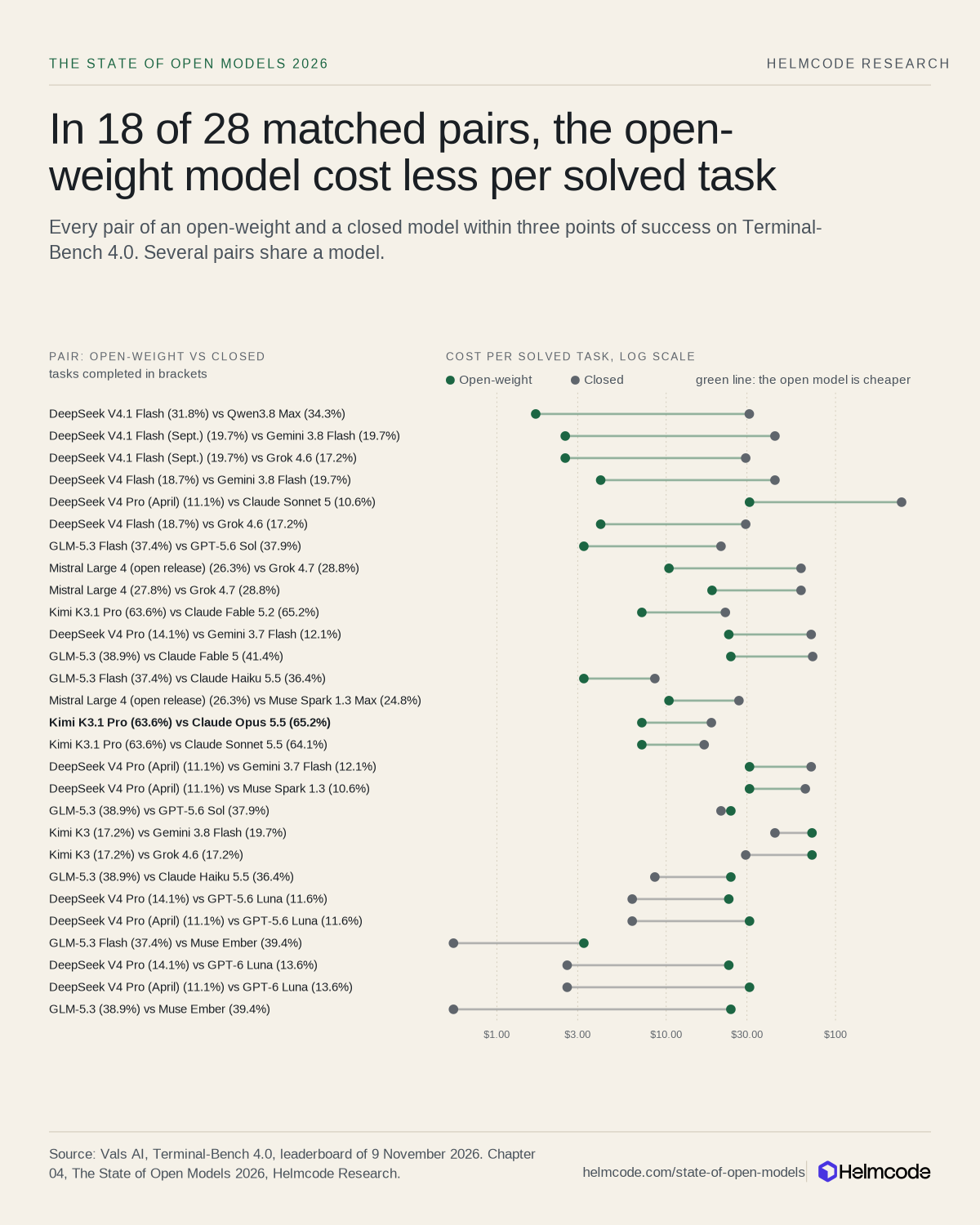
In 18 of 28 matched pairs, the open-weight model cost less per solved task

A cheap token does not make a cheap task: what counts is what a model spends to finish the work, failed attempts included. In 18 of the 28 pairs of an open-weight and a closed model within three points of success, the open-weight model cost less per solved task, a median 2.6 times less; in the others it cost more.

  • The pairs come from the models Vals AI ran and several share a model, so this is not a share of the market.
  • A similar success rate does not mean the same tasks were completed.
How it was measured

Every open-weight/closed pair with success rates within ±3 percentage points, among models that completed at least 10% of the tasks: 28 pairs. A model can be in several pairs (Kimi K3.1 Pro is matched with three closed models).

18 of 28
Open model cheaper
2.6×
Median difference
47
Models in the run

Vals AI, Terminal-Bench 4.0 · Leaderboard of 9 November 2026

05 Enterprise adoption

Companies adopting open models are not dropping closed ones

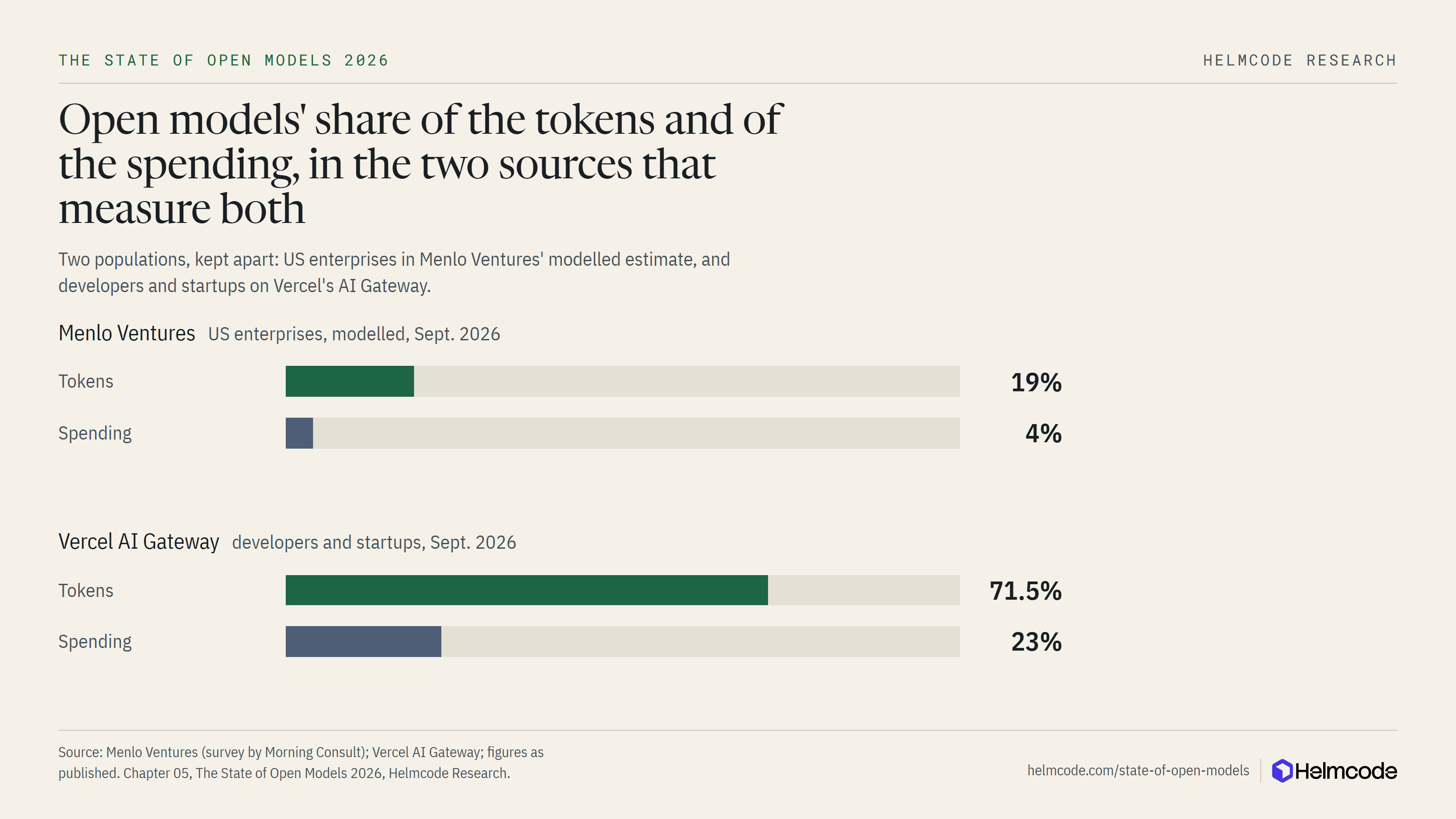
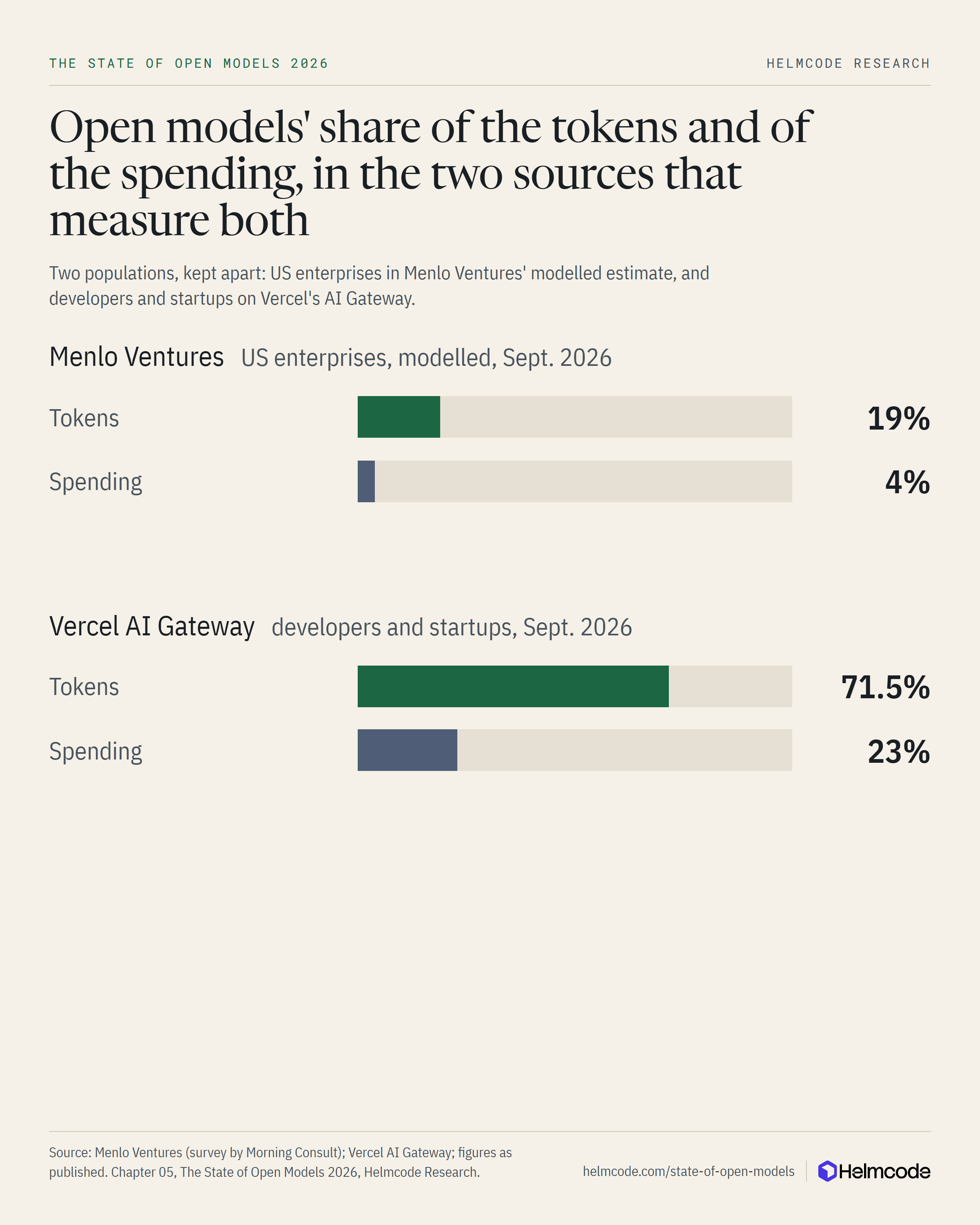
Open models' share of the tokens and of the spending, in the two sources that measure both

Open models processed 19% of US enterprises' tokens but received 4% of the spending, in Menlo Ventures' estimate for September 2026. Of the US businesses on Ramp that paid a platform serving open models in June, 96% also paid OpenAI or Anthropic.

  • Each figure has its own population (US enterprises, businesses on Ramp, a panel of 200 large companies). Do not join them into one series.
  • Menlo Ventures' shares are a modelled estimate built on a survey, not observed traffic.
How it was measured

Figures as their sources publish them. Menlo Ventures: a modelled estimate built on a survey of about 400 US decision-makers (Morning Consult, September 2026). Ramp AI Index: US businesses on Ramp. ETR/Futurum: panel of 200 large, mostly North American companies, September 2026 wave.

19% / 4%
Tokens / spending, Menlo Ventures
96%
Also paid OpenAI or Anthropic, Ramp
42%
Large companies with open models in production, ETR/Futurum

Menlo Ventures; Ramp AI Index; ETR/Futurum · June – September 2026

06 Where open models run

Open weights don't make infrastructure free

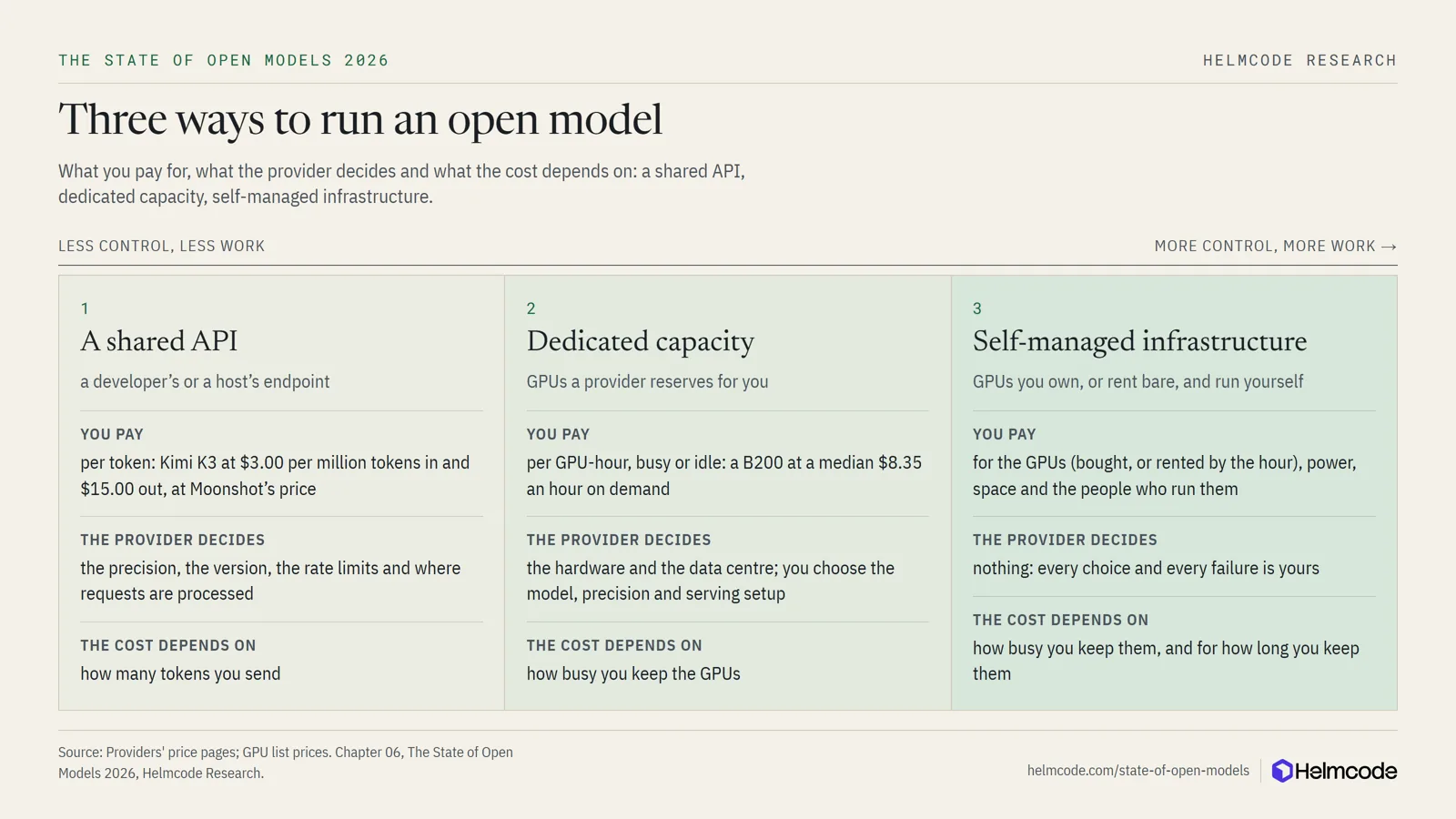
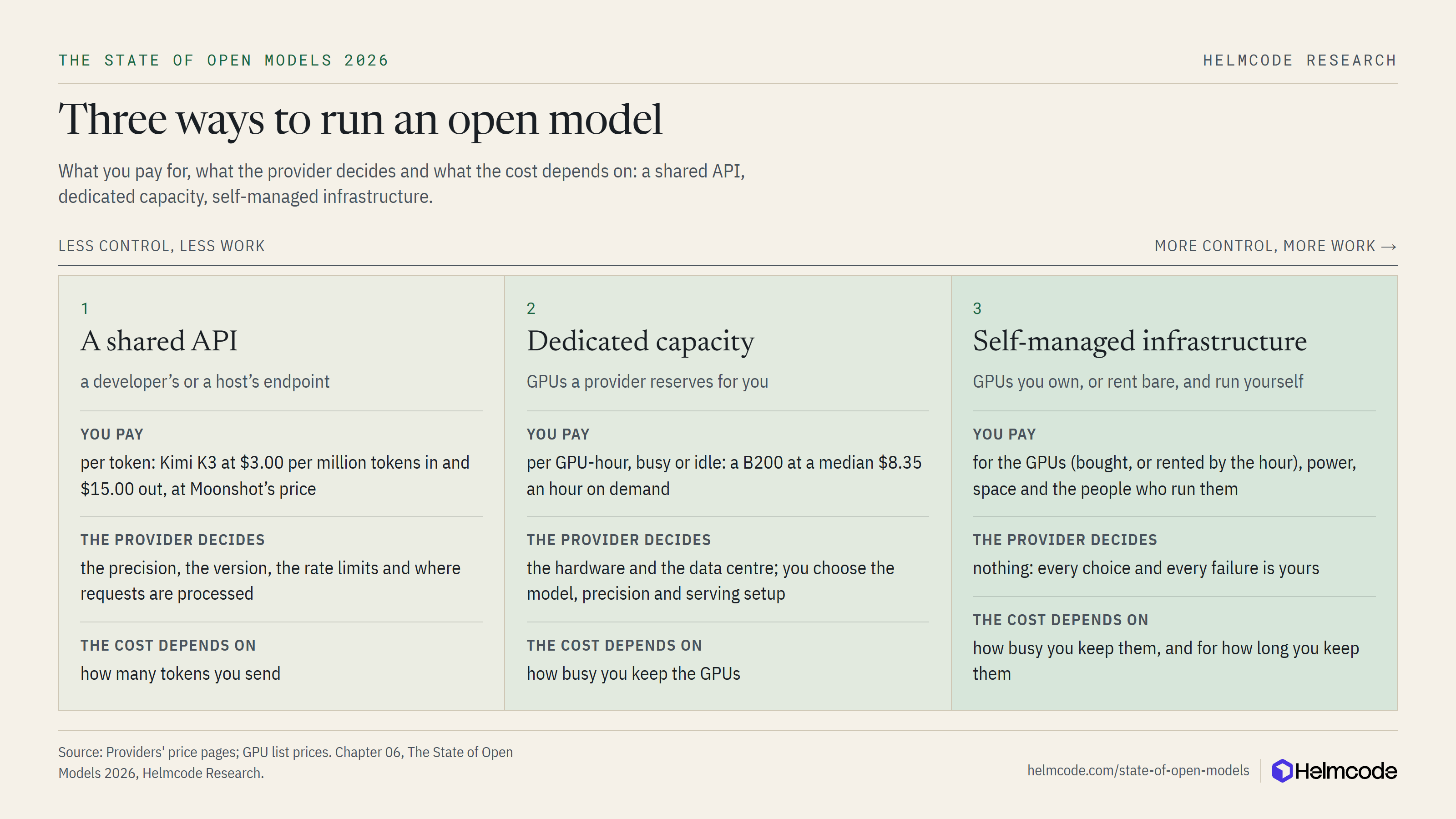
Three ways to run an open model

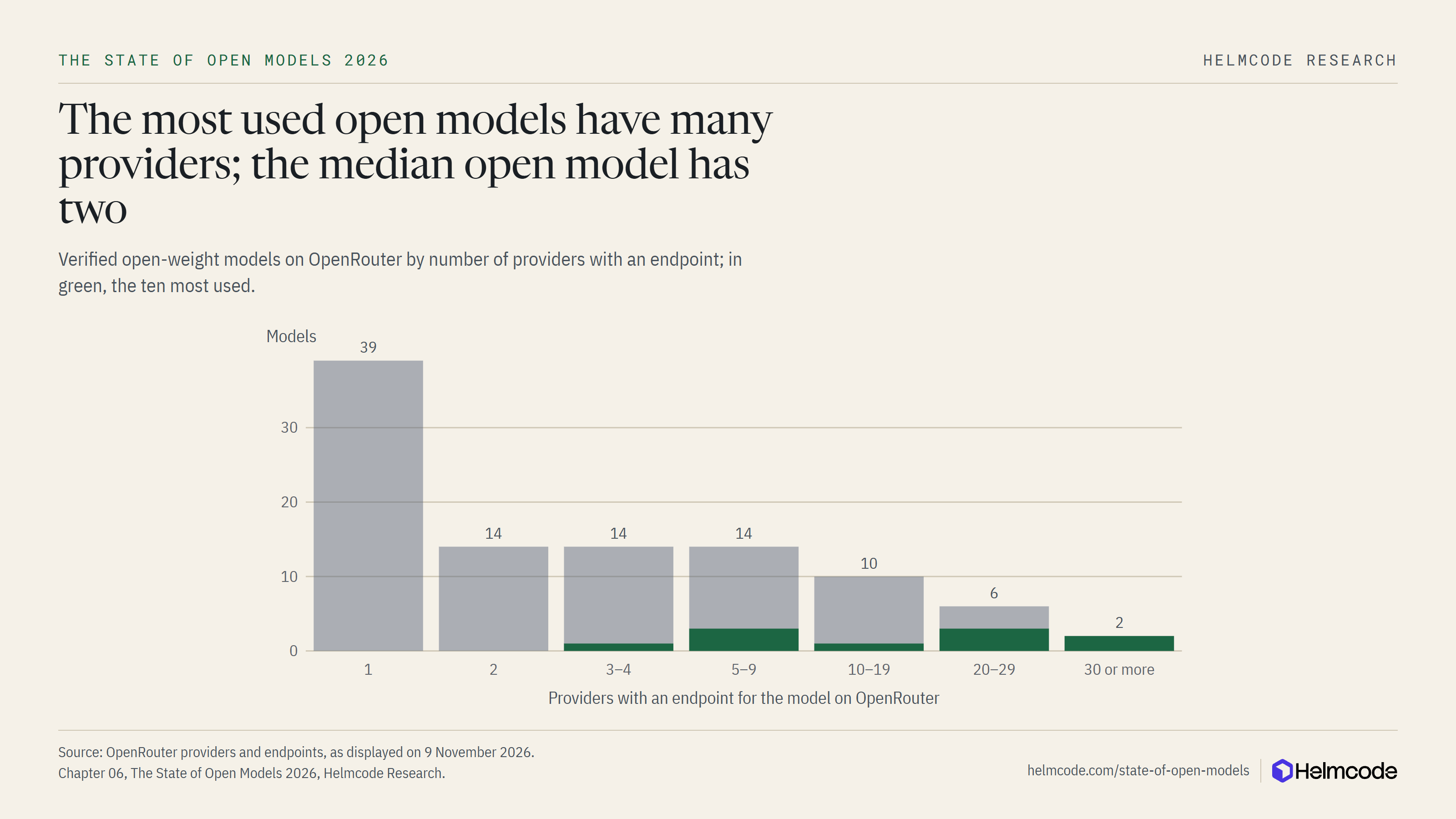
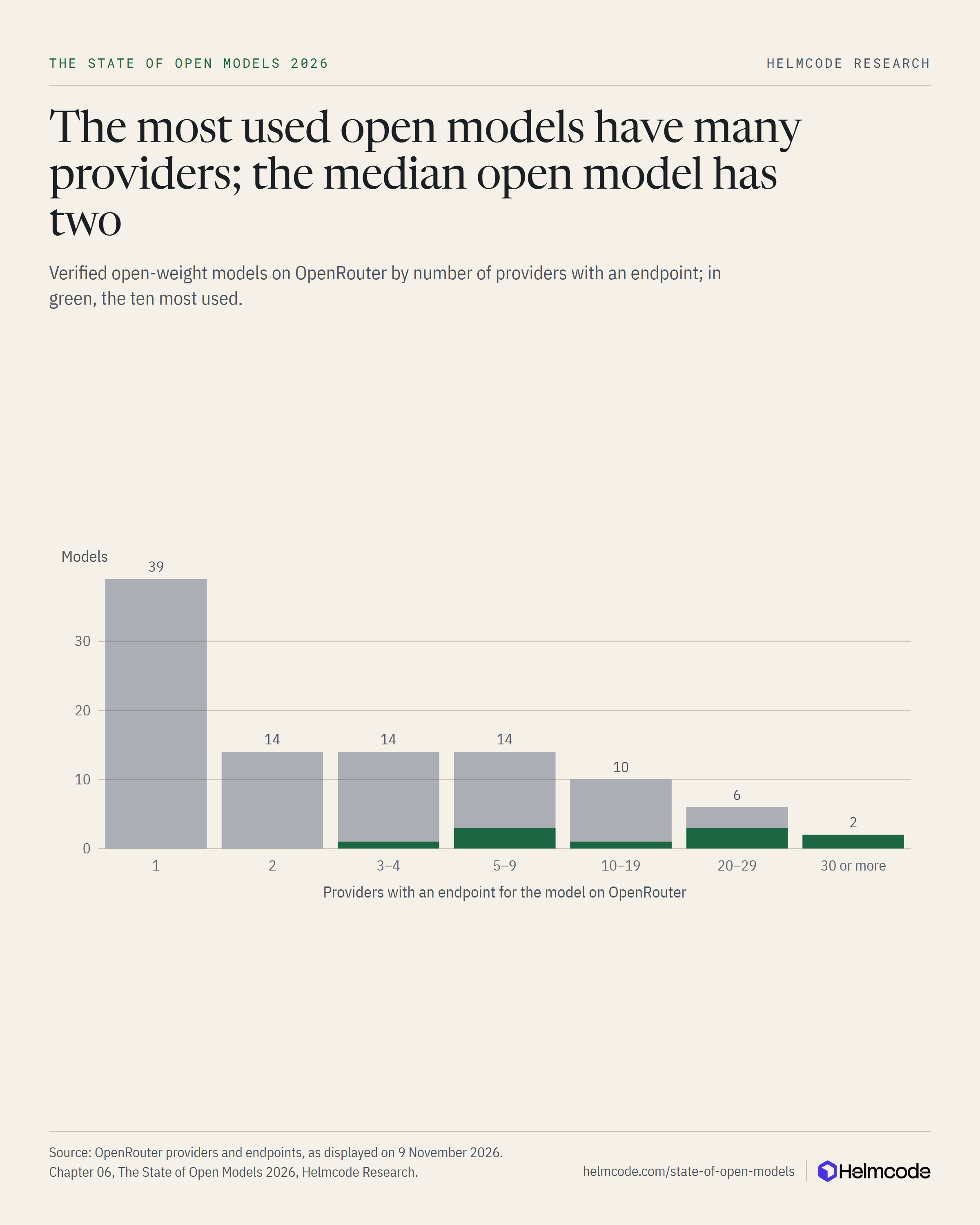
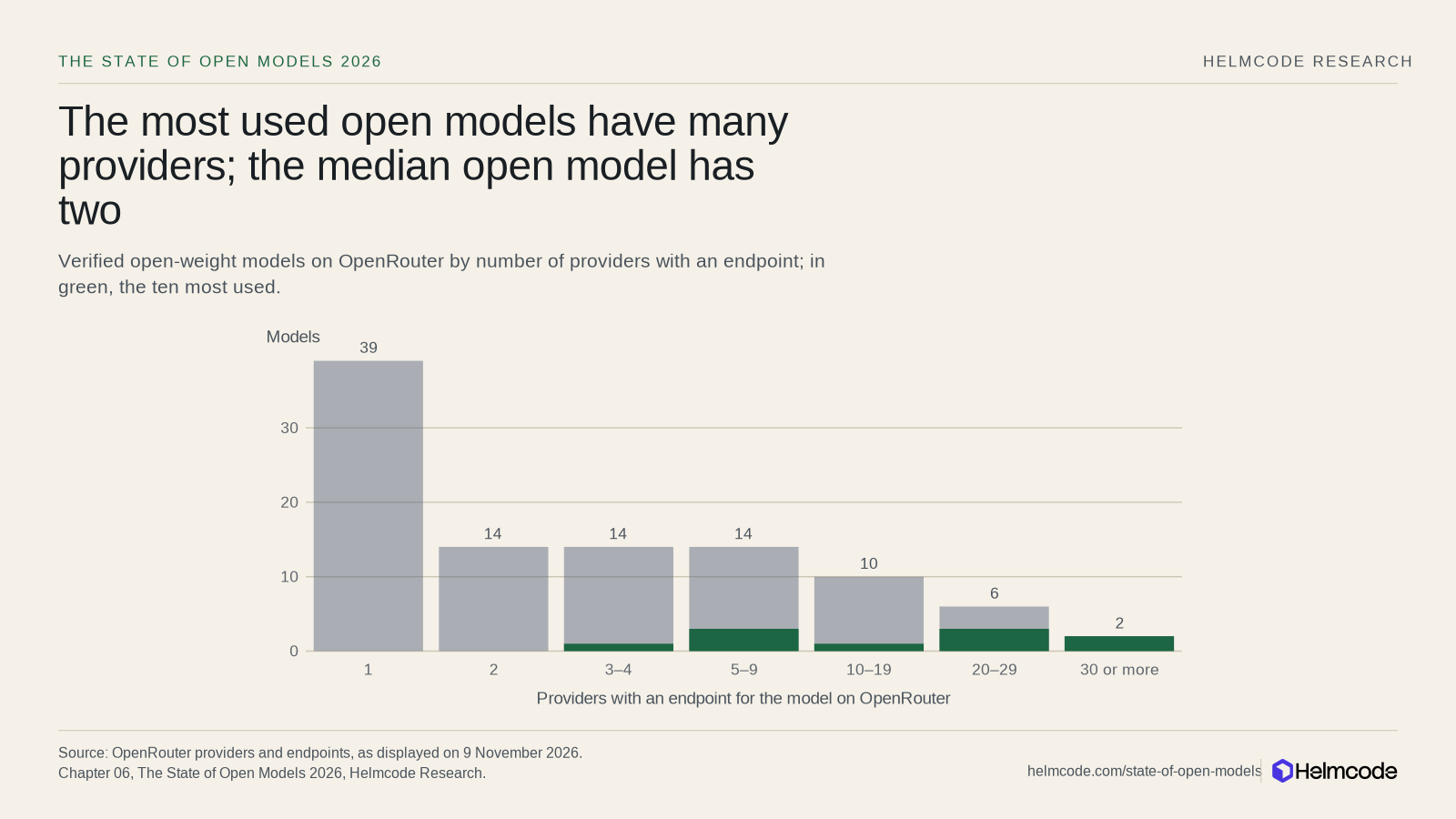
An open model can run through a shared API, on dedicated capacity or on infrastructure you manage. With an API you pay per token; with GPUs you pay for the hours, busy or idle, so the cost depends on how busy you keep them.

  • Chapter 06 models when rented GPUs beat an API, but that comparison is a scenario, not an observed cost; this kit does not quote its thresholds.
  • Provider counts are OpenRouter's listings on one day, not the whole market.
How it was measured

Providers: OpenRouter's public provider and endpoint listings as displayed on 9 November 2026, 99 verified open-weight models. Prices: providers' price pages and GPU list prices, November 2026.

17.5
Providers, ten most used open models
2
Providers, median open model
$8.35
A B200 on demand, median per hour

OpenRouter; providers' price pages · November 2026
02

Charts

High-resolution PNG and, where the chart is vector, SVG. Source and credit are on each image.

03

Film and images

Launch film, 94 seconds, English narration. MP4 · 15.0 MB Subtitles (SRT) Thumbnail

The six chapter illustrations are in the press pack.

04

About the report

Short description

The State of Open Models 2026 is Helmcode Research's report on open-weight AI models. In six chapters it reads public data on downloads, usage, benchmark results, cost per solved task, enterprise adoption and deployment, and sets out the sources, calculations and limitations behind every chart, so that readers can check the work.

Long description

The State of Open Models 2026, published by Helmcode Research on 24 November 2026, describes how the open-model ecosystem looks today, read from the most important sources in the field. Its six chapters examine what gets downloaded, what gets used, how open models compare with closed ones on capability, what a solved task costs, who uses them inside companies and where they run. The report draws on Hugging Face download counts, OpenRouter's public token rankings, Cloudflare Workers AI, benchmark runs by Epoch AI and Vals AI, industry surveys and estimates such as Menlo Ventures, Ramp and JetBrains, and public price lists. Every figure states its own source, period and base, and each chapter's Evidence & Methods page sets out the calculations and limitations. The report's own text, charts and code are released under the MIT licence. It has not been peer-reviewed.

Both descriptions in English and Spanish (TXT)

Using our charts

Charts produced by Helmcode Research may be shared with attribution to Helmcode Research and a link to the original report, subject to the rights and licences of their underlying data sources. The report’s own text, charts and code are released under the MIT licence; each source’s data keeps its own licence. Keep the source line printed on each chart. Licence and sources

Our interest

Helmcode, which publishes this report, builds and operates private inference infrastructure for open-weight models. It therefore has a commercial interest in the subject of the report, and most directly in what running open models costs. No Helmcode figure is used in any calculation. How we handle it

05

Cite and contact

How to cite

Helmcode Research (2026). The State of Open Models 2026. Helmcode, 24 November 2026. https://helmcode.com/state-of-open-models

BibTeX

Press & Research Enquiries

info@helmcode.com

Helmcode Research · Helmcode

helmcode.com/state-of-open-models